


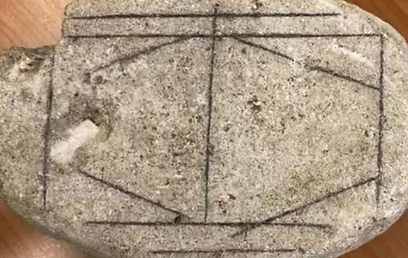
Artificial intelligence has helped solve a 2,000-year-old mystery buried beneath the Dutch city of Heerlen. A limestone slab discovered at the site of ancient Coriovallum—an important Roman settlement—was long suspected to be more than a simple carved stone. Its carefully etched grid and visible wear patterns hinted at purposeful design. Now, through use-wear analysis and advanced AI simulation, researchers have concluded the slab was likely a Roman-era board game used between 250 and 476 AD.
Using microscopic surface analysis, researchers detected abrasion consistent with game pieces being pushed repeatedly across specific lines. But it was the use of an AI simulation platform called Ludii that ultimately brought clarity. By running thousands of automated games across 130 potential rule variations, AI agents recreated likely gameplay scenarios. The results strongly suggested the slab was used for a “blocking” style strategy game—one player attempting to trap the other’s pieces. This marks the first time AI-driven simulated play has been paired with archaeology to identify an ancient game, pushing known board game history back several centuries.
SOURCE: JPost