


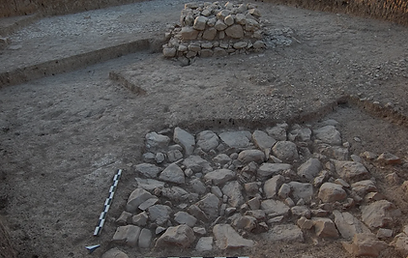
Recent excavations in northern Iraq have uncovered a 1,500-year-old Christian complex near a Sasanian-era fortress, offering a rare glimpse into a world where early Christians lived alongside adherents of Zoroastrianism. The site, dated to around 500 A.D., includes architectural features consistent with a church—pillars, a multi-nave layout, and pottery marked with a Maltese cross—positioned just steps away from military structures likely occupied by Zoroastrians. The find, announced by Goethe University Frankfurt, points to an established Christian presence operating in close proximity to a Sasanian-era military installation.
Zoroastrianism, the state religion of the Sasanian Empire, was built around cosmic dualism: a moral struggle between truth and order, represented by Ahura Mazda, and chaos and deception, represented by Angra Mainyu. Fire, light, ritual purity, and reverence for creation were central, along with a strong emphasis on ethical behavior—good thoughts, good words, good deeds. While often mislabeled as monotheistic, Zoroastrianism includes a hierarchy of spiritual beings and cosmic forces.
In the 7th century, the Islamic conquests swept through the Persian world, bringing the slow but decisive collapse of Zoroastrian dominance. Under the Rashidun and later Umayyad Caliphates, Persia fell to Islam, and Zoroastrians were systematically displaced through taxation, legal inferiority, and cultural pressure. While initially tolerated as “People of the Book” in limited ways, Zoroastrians were subjected to the jizya tax, excluded from political power, and incentivized—often coercively—to convert. Fire temples were destroyed or repurposed, sacred practices were restricted, and over generations, one of the world’s most influential ancient religions was reduced to a small remnant.
SOURCE: Fox News